 English
 Russian

In secondary and tertiary hard-rock crushing circuits, tramp iron (such as broken loader teeth, drill steels, and excavator bucket shanks) represents the most destructive threat to cone crusher integrity. While modern multi-cylinder hydraulic cone crushers are engineered with automated tramp release cylinders, a loss of nitrogen pre-charge pressure inside the bladder accumulators can transform a routine passing event into catastrophic main frame cracking, bronze bushing seizure, or socket ball failure.
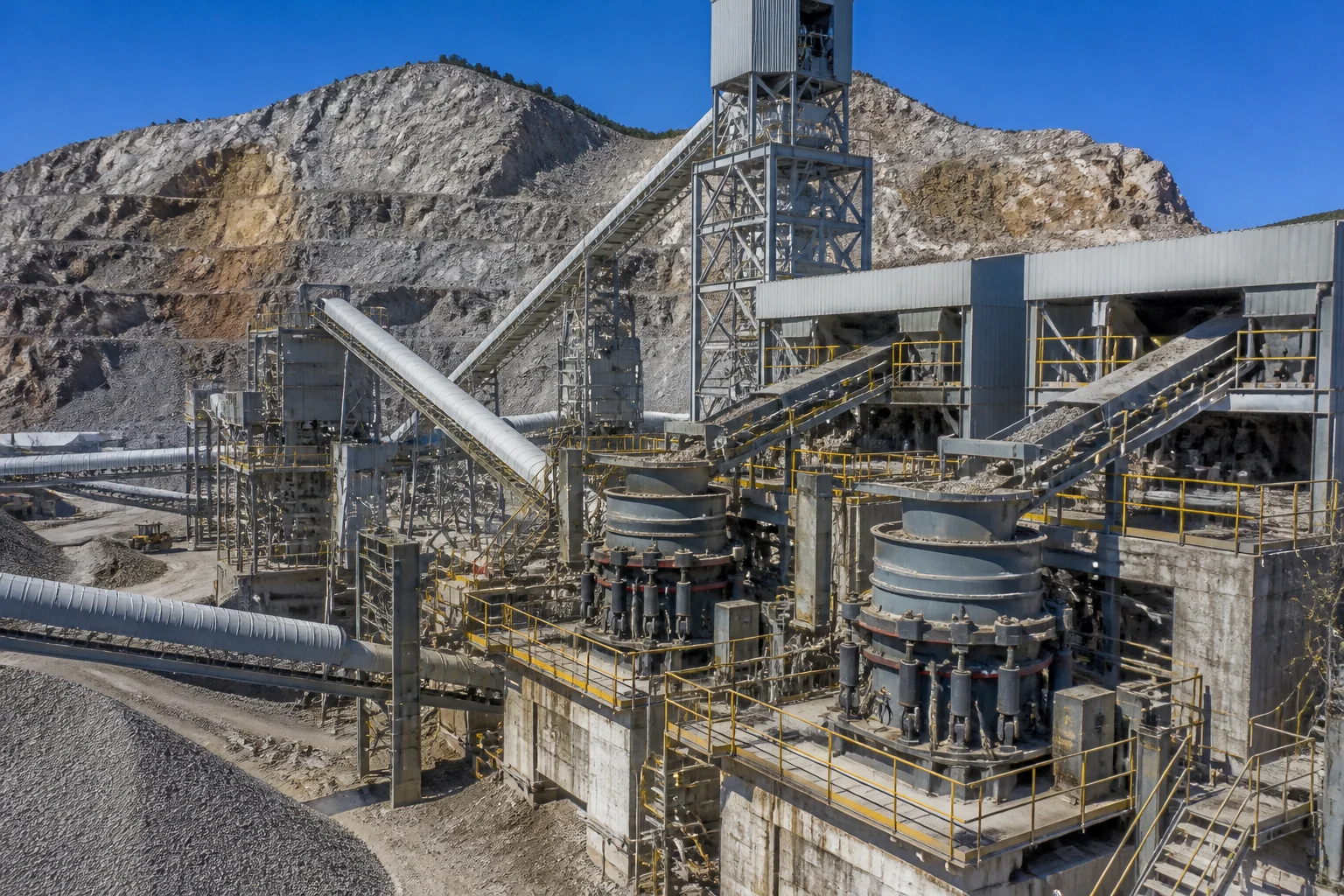
Figure 1: Heavy-duty secondary and tertiary hydraulic cone crushers equipped with nitrogen bladder tramp release accumulators.
1. Anatomy of the Hydraulic Tramp Release Mechanism
Unlike archaic mechanical spring-clamped crushers, multi-cylinder hydraulic cone crushers utilize double-acting hydraulic cylinders linked directly to nitrogen-charged bladder accumulators:
Instantaneous Fluid Displacement: When uncrushable tramp metal enters the crushing chamber, crushing forces spike instantaneously beyond system thresholds (typically exceeding 180–210 bar). Hydraulic fluid from the upper cylinder chambers is violently forced into the bladder accumulators within milliseconds.
Nitrogen Compression Cushion: The compressed dry nitrogen gas bladder absorbs the fluid volume, allowing the entire upper frame (adjustment ring and bowl) to lift smoothly, opening the closed side setting (CSS) and permitting the tramp object to discharge freely.
Automatic Reset & Re-clamping: Once the tramp metal clears the discharge gap, the stored pneumatic potential energy inside the accumulators forces the hydraulic oil back into the cylinders, reseating the bowl firmly onto the lower main frame without requiring manual operator intervention.
2. Nitrogen Pre-Charge Pressure Calibration & Testing
The performance of the tramp release circuit is strictly dictated by maintaining the correct nitrogen pre-charge pressure relative to operating hydraulic clamping pressure. In Sanming Machinery Multi-Cylinder Hydraulic Cone Crushers, the baseline rules are:
Pre-Charge Ratio: The nitrogen pre-charge pressure ($P_0$) must typically be calibrated to 65%–70% of the normal hydraulic hold-down clamping pressure ($P_{clamp}$). For a clamping pressure of 180 bar, $P_0$ should be calibrated precisely to 120–125 bar at ambient temperature (20°C).
Consequences of Under-Charging ($P_0 < 50\%$): If nitrogen leaks out, the rubber bladder bottoms out against the fluid port during normal crushing strokes. This creates severe hydraulic shock waves, rupturing high-pressure hoses and inducing severe bowl chatter under high-tonnage choke feed.
Consequences of Over-Charging ($P_0 > 85\%$): If over-charged, the accumulator cannot absorb displaced fluid quickly enough during tramp passage. Peak hydraulic pressure spikes beyond 300 bar, cracking the cylinder mounting flanges and bending the eccentric main shaft.
| Symptom / Failure Mode | Probable Root Cause | Verification Procedure | Corrective Action |
|---|---|---|---|
| Upper Frame Bouncing During Normal Feed | Accumulator pre-charge pressure too low or bladder ruptured | Depressurize hydraulic circuit; check Schrader valve with test gauge | Recharge with dry nitrogen to 120 bar; replace torn bladder |
| Slow Frame Return After Tramp Discharge | Throttle check valve jammed with contaminated oil; cylinder seal binding | Inspect return orifice manifold; sample oil cleanliness (ISO 4406) | Flush manifold blocks; flush oil filters (10-micron nominal) |
| Frequent High-Pressure Relief Trips | Excessive fines in feed causing packing; incorrect CSS setting | Sample feed gradation; check for >15% sub-mesh fines | Scalp fines on pre-screen; open CSS to recommended operating gap |
3. Periodic Maintenance SOP for Accumulator Safety
Never service an accumulator without completely de-energizing and venting hydraulic fluid pressure to 0 bar. The safety protocol mandates:
Quarterly Nitrogen Pressure Verification: Test pre-charge pressure every 250 operating hours using a certified charging kit equipped with an isolator gauge. Only use dry industrial nitrogen (N2); never use compressed air or oxygen, which creates an explosive combustion environment when mixed with hydraulic mineral oil.
Bladder Integrity Inspection: Depress the gas valve core momentarily. If hydraulic fluid sprays from the gas valve, the internal synthetic elastomer bladder is ruptured and must be replaced immediately.
Proportional Relief Valve Calibration: Inspect the main pilot-operated relief valves annually to ensure safety bypass opens reliably within 20 milliseconds during continuous uncrushable events.
4. Technical FAQ: Cone Crusher Hydraulic Protection
Q1: Why does nitrogen pre-charge drop during winter operations?
A: Gas laws dictate that nitrogen pressure varies directly with temperature ($P_1/T_1 = P_2/T_2$). When ambient quarry temperatures plunge from 25°C to -20°C, nitrogen pressure drops by approximately 15%, requiring seasonal top-up calibration.
Q2: Can I continue crushing if one accumulator on the circuit fails?
A: No. Operating with an isolated or failed accumulator causes uneven cylinder lifting, twisting the adjustment ring and galling the internal bronze frame bushings.
Q3: How does Sanming Machinery automate tramp clearing?
A: Sanming Machinery Cone Crushers feature an automated clearing cycle: if an oversized steel piece jams the cavity, the PLC automatically activates the hydraulic pump to raise the bowl to maximum lift, discharges the obstruction, and returns to the exact pre-set CSS within 45 seconds.
5. Hydraulic Engineering and Technical Field Service
Sanming Machinery provides complete hydraulic power units, certified bladder accumulators, and PLC control retrofits for mining cone crushers. Contact our hydraulic specialists for on-site circuit audits, pressure calibration kits, and emergency cylinder rebuild services.