 English
 Russian
In open-pit copper, gold, and iron ore operations, selecting between a heavy-duty primary gyratory crusher and a large primary jaw crusher is one of the most consequential capital expenditure decisions for processing plant designers. While both machines serve as the frontline comminution asset converting blasted run-of-mine (ROM) ore into conveyable fractions, their operational dynamics, civil foundation requirements, feed presentation capabilities, and life-cycle costs diverge dramatically at specific throughput thresholds.
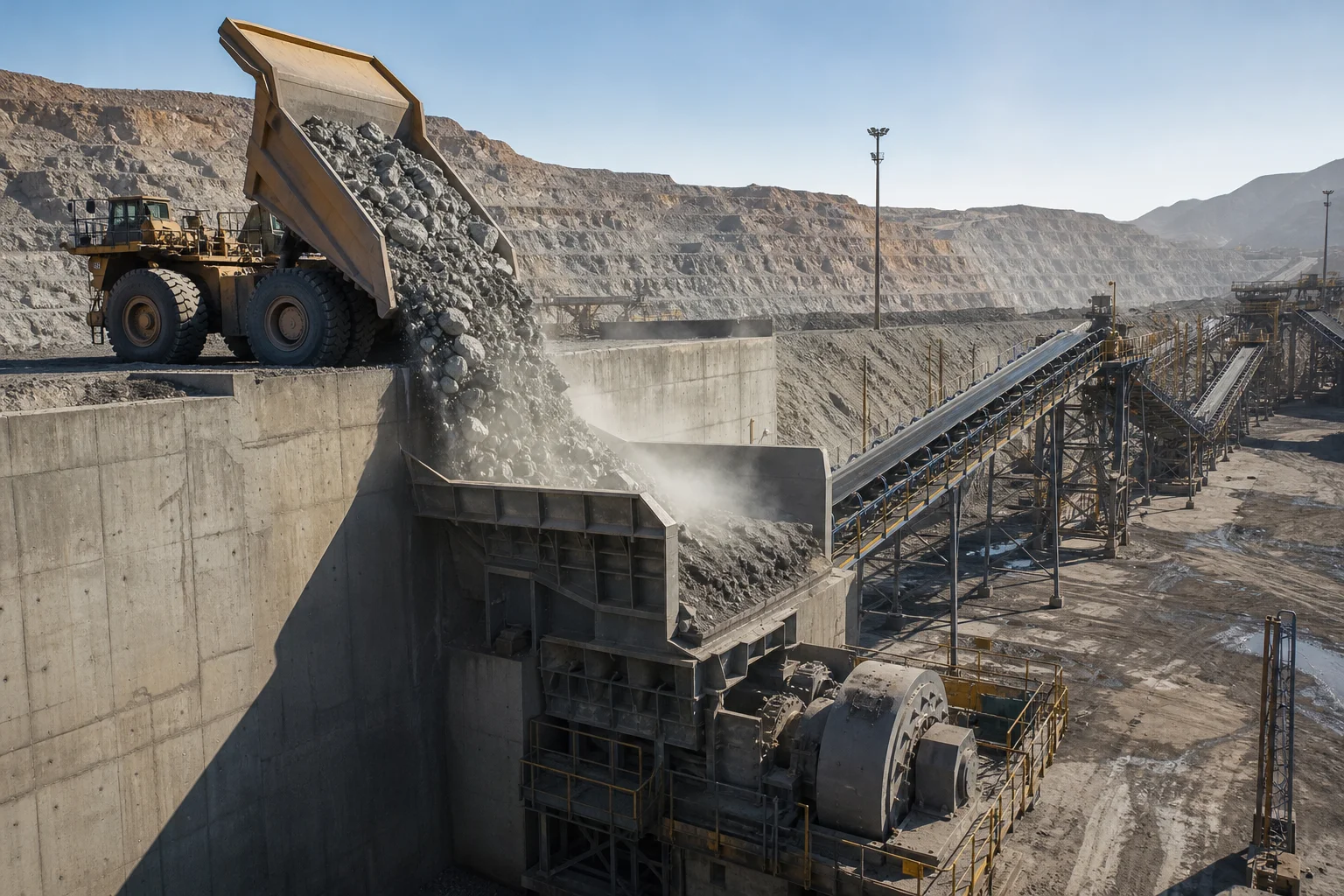
Figure 1: Heavy-duty primary crushing station layout comparing direct-dump gyratory installation and feeder-fed jaw crusher station.
1. Critical Selection Metric: The 1,000–1,200 tph Economic Threshold
The definitive metric governing primary crusher selection is instantaneous and sustained crushing throughput:
Below 800–1,000 tph: A large single-toggle jaw crusher (such as the Sanming Machinery Heavy-Duty Primary Jaw Crusher PE-1200x1500 or PE-1500x1800) represents the lowest initial capital cost (CAPEX) per ton of installed capacity. It pairs effectively with vibrating grizzly feeders to scalp sub-size fines before entering the crushing chamber.
Above 1,200–1,500 tph: A single primary gyratory crusher (e.g., 54-75 or 60-89 class) becomes mechanically and economically superior. The gyratory crusher utilizes a 360-degree continuous crushing action, crushing material during the entire revolution of its eccentric, whereas a jaw crusher only crushes during the forward stroke (roughly 50% of the eccentric rotation cycle).
| Design Parameter | Heavy Primary Jaw Crusher | Heavy Primary Gyratory Crusher |
|---|---|---|
| Crushing Motion | Intermittent reciprocating stroke (50% duty cycle) | Continuous 360° eccentric rotation (100% duty cycle) |
| Max Recommended Throughput | Up to 800–1,200 tph (modular dual jaw for higher) | 1,500 to 8,000+ tph continuous capacity |
| Truck Dump Method | Requires dump pocket, rock box & apron/vibrating feeder | Direct dual-sided truck dumping directly into chamber |
| Civil Foundation Height | Moderate excavation (10–15 m total plant drop) | Substantial deep excavation (25–35 m multi-level vault) |
| Initial Installed CAPEX | Baseline (1.0x) - lower structural & crane costs | Higher (2.2x to 3.5x baseline) due to massive civil works |
2. Feed Presentation and Truck Dumping Dynamics
A major design advantage of the primary gyratory crusher is its ability to accept direct dump from 150- to 300-ton haul trucks simultaneously from opposite sides without requiring a dedicated apron feeder. The steep, circular bowl accepts large boulders and permits a surge pocket directly beneath the spider arm assembly.
Conversely, a primary jaw crusher requires controlled feed via an apron feeder or heavy vibrating grizzly feeder to prevent bridging and chamber jamming. Dumping directly onto the jaw dies from large haul trucks causes severe shock loading on the pitman bearings and eccentric shaft. However, the jaw crusher accommodates slabby boulders with larger single-dimension elongation far better than a gyratory of equivalent feed opening width.
3. Civil Engineering & Excavation Footprint Comparison
While gyratory crushers deliver unrivaled volumetric capacity, their civil infrastructure is massive. A typical 60-89 gyratory requires a multi-story reinforced concrete vault spanning 25 to 35 meters below grade to accommodate the bottom-mounted hydraulic cylinder (Hydroset), countershaft drive, and discharge surge pocket. Heavy overhead gantry cranes (75–100 ton capacity) must be installed for mantle and main shaft maintenance.
For open-pit operations with shallow ore reserves or remote locations with difficult bedrock excavation, Sanming Machinery Modular Jaw Crushing Stations offer rapid site assembly, lower reinforced concrete requirements, and straightforward modular relocation when mining pit rims advance.
4. Technical FAQ: Primary Crushing Selection
Q1: What ore characteristics favor a jaw crusher over a gyratory at 1,000 tph?
A: Highly slabby or layered rock with high compressive strength, combined with intermittent haul truck delivery schedules. Jaw crushers handle slab-shaped boulders more forgivingly and have lower idle power consumption during feed pauses.
Q2: How does liner wear cost (OPEX) compare between both units?
A: In highly abrasive silica or quartzite ores, gyratory concave rings and mantles typically yield lower wear cost per ton due to full circumferential distribution of wear, whereas jaw fixed and swing dies experience concentrated wear in the lower 30% crushing zone.
Q3: Can a dual-jaw configuration compete with a single gyratory crusher?
A: Yes. In operations targeting 1,200–1,600 tph, two parallel primary jaw crushers provide built-in plant availability redundancy: one jaw can undergo liner replacement while the second continues processing at 50% capacity.
5. Engineering Consultation and Plant Flowsheet Support
Sanming Machinery supplies primary crushing stations engineered for extreme open-pit conditions, from arctic permafrost to high-altitude Andean copper belts. Contact our mineral processing engineering group for crushing chamber simulations, boulder breakage modeling, and complete crushing station layout drawings.