 English
 Russian
Author: Hangzhou Sanming Machinery Co., Ltd. Technical Application Engineering Team
Published: October 13, 2026
Direct Overview: Tertiary Crushing and Sand Comminution Metrics
In commercial aggregate and mining operations, the transition from secondary cone crushing to tertiary shaping and sand manufacturing represents the sharpest cost boundary in the plant. Processing high-abrasion, high-silica rocks such as granite, quartzite, and basalt (compressive strengths exceeding 220-300 MPa, quartz content greater than 35%) exposes conventional impact crushers to catastrophic wear rates and unstable product grading.
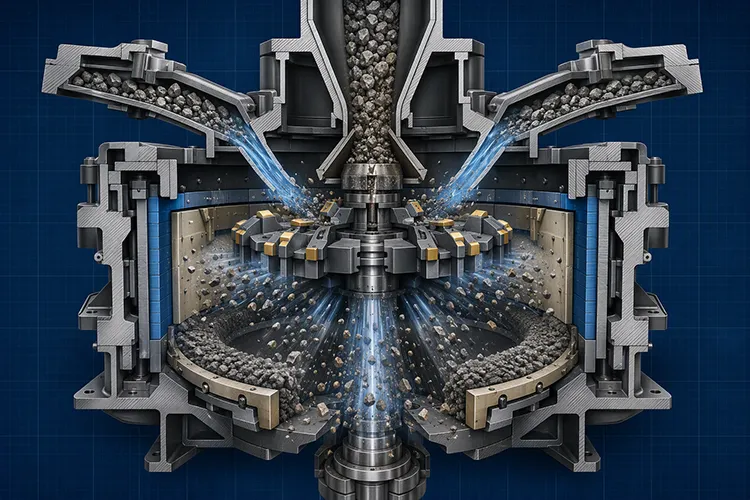
Modern Vertical Shaft Impact (VSI) crushers resolve this challenge by converting kinetic energy into autogenous particle collision. By accelerating material through a high-speed balanced rotor (peripheral linear speeds of 60-78 m/s), VSI units utilize the incoming stone mass to fracture and shape itself.
Key engineering benchmarks achieved in verified plant installations include:
Flakiness Index (FI) Suppression: Decreases elongated and flaky particle content from 22-26% (typical after cone crushers) to 6-9%, meeting strict ASTM C33 and EN 12620 superpave asphalt and high-strength concrete aggregate standards.
Controlled Gradation Modulus: Produces consistent manufactured sand with a Fineness Modulus (FM) controllable between 2.4 and 3.0, generating a continuous sieve curve without excessive filler dust generation (<75 micron fines held under 7-10%).
Wear Operating Cost Reduction: Autogenous "Rock-on-Rock" chamber lining cuts metallic wear replacement expenses by 55-68% compared to direct mechanical impact mechanisms on hard rock.
Core Engineering Comparison: Rock-on-Rock vs. Rock-on-Anvil
Selecting the optimal internal chamber configuration directly determines commercial viability. Operating an incorrect chamber setup in high-quartz rock can increase maintenance expenses by more than 300%.
Technical Specification and Performance Matrix
Rotor Dynamics and Wear Metallurgy Optimization
The high-speed rotor represents the technological core of the VSI machine. In Hangzhou Sanming Machinery's VSI series, several proprietary design principles extend rotor component life and lower operational downtime.
1. Deep-Cavity Rotor Hydrodynamics
The three-port and four-port deep-cavity rotor geometries maximize internal dead-bed volume. As material enters the central feed cone, it establishes natural static rock angles inside each discharge port. The accelerated stream travels over this mineral buffer, so moving particles only touch stationary stone rather than base structural steel.
2. Multi-Segment Composite Tungsten Carbide Wear Tips
Traditional single-piece alloy tips crack when subjected to tramp iron or micro-shocks. Sanming Machinery implements multi-segment tungsten carbide tips with precision molybdenum-cobalt matrix bonding:
Primary Tip Block: Concentrates 70% of structural carbide thickness at the high-wear exit radius.
Backing Plate Interlocking: Protects the rotor forged steel frame from eddy erosion if tips wear past safe thresholds.
Reversible Top and Bottom Wear Plates: Allows 180-degree flipping to balance asymmetric wear patterns caused by gravitational feed bias, doubling plate life.
3. Dual-Flow Cascade Fluidized Crushing
By splitting total incoming feed between central rotor injection (60-70%) and perimeter gravitational cascade (30-40%), the machine fluidizes the impact ring. High-speed rock ejected from the rotor impacts a continuous falling curtain of stone in mid-air. This increases inter-particle collision density without increasing motor power demand, reducing specific electricity consumption per ton by 18-24%.
Quantitative Operating Benchmarks and TCO Cost Analysis
In a standard commercial granite quarry producing 200 metric tons per hour (t/h) of aggregate and sand operating 3,500 hours annually (700,000 metric tons total throughput), the choice of shaping equipment impacts the balance sheet directly.
Operational Cost Calculation Model
The Total Cost of Ownership (TCO) per ton is calculated using standard comminution accounting:
Total Operating Cost per Ton ($/t) = Wear Consumables Cost ($/t) + Electrical Energy Cost ($/t) + Planned Maintenance Labor ($/t)
Where:
Wear Consumables Cost ($/t) = Total Cost of Rotor Parts and Liners ($) / (Component Service Hours * Effective Production Rate t/h)Electrical Energy Cost ($/t) = Motor Power Consumption (kW) * Grid Rate ($/kWh) / Production Rate (t/h)
Economic Comparison: Tertiary VSI vs. High-Speed Tertiary Cone Crusher
Technical Maintenance Protocol and Operational Safeguards
To prevent catastrophic bearing failure and maintain dynamic rotor balance, operators must follow strict plant procedures:
Vibration Sensor Interlocks: The unit must be equipped with industrial piezoelectric vibration transmitters calibrated to trigger warning alarms at 4.5 mm/s RMS and emergency motor trip-out at 7.0 mm/s RMS. Operating with uneven rotor wear causes rapid bearing breakdown within hours.
Dynamic Rotor Pair Balancing: When changing worn tungsten carbide tips, always weigh replacement components in diametrically opposed pairs. Weight differences across 180-degree opposing ports must not exceed 2.0 grams.
Automated Thin-Oil Circulating Lubrication: Bearings must be lubricated via a dedicated dual-pump oil station incorporating water-cooling or air-radiator heat exchangers, 25-micron filtration, and digital pressure/temperature interlocks. Bearing operating temperatures must remain below 65 degrees Celsius.
Frequently Asked Questions (FAQ)
When should a quarry choose Rock-on-Rock (ROR) over Rock-on-Anvil (ROA) configuration?
Quarries should select Rock-on-Rock (ROR) whenever the feed material contains over 5% silica or has a Mohs hardness greater than 5.5, including granite, basalt, quartzite, river gravel, and copper ores. In these abrasive materials, ROA alloy anvils wear out within 40-80 operating hours, creating prohibitive consumable expenses. ROR forms an internal dead bed of rock that absorbs abrasion, making it the most cost-effective choice. ROA should be reserved strictly for non-abrasive limestone and dolomite where maximum single-pass reduction is required.
How does the VSI crusher ensure manufactured sand meets ASTM C33 specifications?
ASTM C33 concrete aggregate requires continuous gradation without gap intervals and an optimal Fineness Modulus (FM) between 2.3 and 3.1. The VSI achieves this through adjustable rotor peripheral speeds (via variable frequency drive from 55 to 75 m/s) and cascade feed ratios. Higher speeds increase particle kinetic energy to shatter intermediate fractions into 0.15-0.6 mm grains, while cascade feeding prevents excessive over-grinding into sub-75 micron rock powder.
What is the typical replacement interval for rotor wear tips in abrasive granite processing?
In processing hard granite with 40-50% quartz content, Sanming Machinery's multi-segment tungsten carbide rotor tips deliver an operating life of 90-140 hours under continuous choke-feed conditions. When processing less abrasive river gravel or basalt, tip life extends to 180-260 hours. Routine inspection every shift is necessary to ensure wear has not penetrated past the backing plate into the structural rotor forged body.
Can a VSI crusher handle wet or sticky feed materials during rainy quarry seasons?
VSI crushers operate effectively with surface moisture contents up to 3-5%. However, if the feed contains plastic clay or surface moisture exceeds 6-8%, material tends to build up excessively inside the rotor ports and along the internal chamber walls, choking throughput and causing severe rotor imbalance. In wet operating environments, quarries must install pre-screening grizzly feeders to scalp off 0-5 mm natural clay fines before introducing stone into the VSI.
🌐 Русская версия: Центробежно-ударные дробилки VSI для производства кубовидного щебня и песка