 English
 Russian
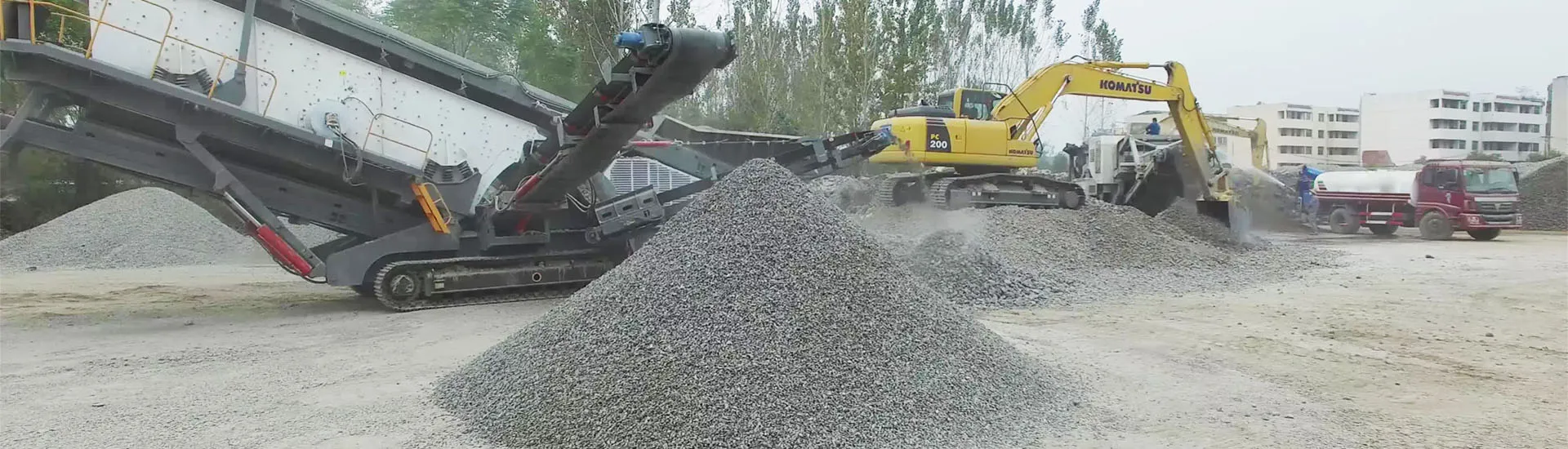
Setting up a hard-rock crushing line in regions like Sub-Saharan Africa requires matching equipment specs directly to site geology and power limitations. Choosing between primary jaw crushers and secondary cone crushers directly impacts fuel consumption, replacement intervals for manganese Wear parts, and total cost per ton.
To lower operational expenses, aggregate producers and mine operators must evaluate feed size, compressive strength, and final product gradation before buying machinery from a reliable crusher supplier.
Primary vs. Secondary Equipment Specifications
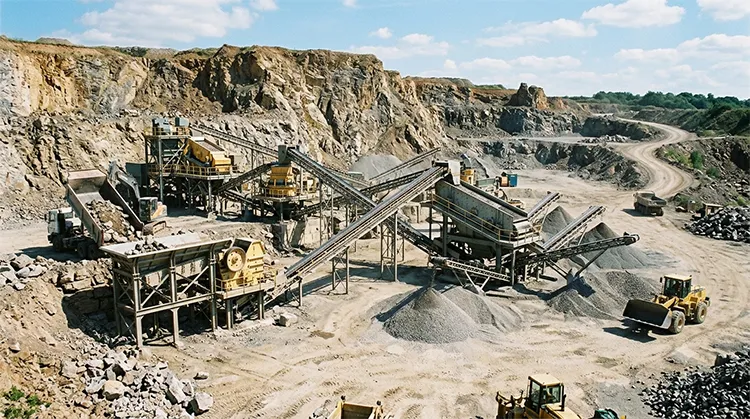
A standard Crusher Plant relies on a primary jaw crusher for coarse reduction (up to 800 mm feed), followed by a cone or impact crusher to produce 0-5mm, 5-10mm, 10-20mm aggregate fractions.
| Parameter | Jaw Crusher (Primary Stage) | Cone Crusher (Secondary/Tertiary) |
| Max Feed Size | Up to 1,020 mm | Up to 230 mm |
| Crushing Action | Compression via movable jaw | Eccentric gyration in concave bowl |
| Ideal Materials | Hard basalt, granite, copper ore | Abrasive stone, gravel, iron ore |
| Power Consumption | 55 kW – 160 kW | 90 kW – 315 kW |
| Manganese Wear Life | 1,200 – 2,500 hours | 800 – 1,800 hours |
| Target Output (TPH) | 50 – 600 TPH | 45 – 450 TPH |
5 Main Factors Driving Total Operating Costs
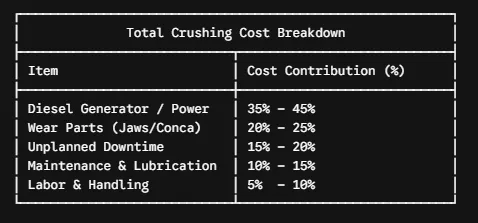
1.Power Grid Availability: Where grid power is unstable, operating a diesel generator adds $0.08 to $0.15 per ton in fuel costs. High-torque electric motor drives with soft-starters reduce peak generator draw.
2.Moisture and Clay Content: Sticky feed material causes frequent blockages in crushers, clogging the receiving hopper and burning drive belts. Installing a vibrating grizzly feeder with a pre-screening deck bypasses fines under 40mm before the jaw opening.
3.Manganese Alloy Selection: Utilizing Mn18Cr2 or Mn22Cr2 jaw plates extends wear life by 30% when crushing abrasive granite compared to standard Mn13 steel.
4.Mobility Needs: A track-mounted mobile crusher eliminates stationary foundation civil works, saving up to $40,000 in initial site installation costs for short-term road construction projects.
5.Structural Integrity: Heavy-duty fabricated steel frames withstand high continuous impact in remote gold, copper, and iron Mining project sites.
Operators seeking durable plant setups can explore engineered crushing lines and spare parts catalogs at
Recommended Plant Configurations for Aggregate & Mining
100–150 TPH Aggregate Line: PE750×1060 Jaw Crusher + CS160 Cone Crusher + 3-Deck 2160 Vibrating Screen.
200–300 TPH Mining Line: PE900×1200 Jaw Crusher + HP300 Hydraulic Cone Crusher + Heavy-duty Grizzly Feeder.
Using verified machinery sourced from experienced crusher manufacturers ensures direct access to OEM replacement liners, toggle plates, and main shafts without long lead times.
Selecting the right heavy Mining Machinery requires matching motor horsepower and chamber geometry to your specific rock density. Deploying robust Quarry Equipment minimizes unscheduled maintenance stops and maintains steady production yields across hard rock operations. When sourcing reliable Construction Machinery, verify that the structural steel and hydraulic components are rated for continuous ambient temperatures above 40°C.
FAQ:
Q1: What is the average equipment budget for a 100-150 TPH crushing plant?
A complete stationary Crusher Plant delivering 100–150 tons per hour typically ranges between $130,000 and $260,000, depending on hydraulic options, generator sizing, and conveyor layout.
Q2: How do you prevent blockages in crushers when processing sticky rock?
Install a double-deck vibrating grizzly feeder ahead of the primary jaw. Setting a bypass gap allows wet fines (0-30mm) to bypass the jaw jaw chamber completely, stopping mud packing and chamber clogging.
Q3: When should you select a cone crusher over an impact crusher?
Use a cone crusher when processing hard, abrasive rock (like granite, quartzite, or basalt with silica content over 60%). Impact crushers are better suited for medium-hard stone like limestone due to higher blow-bar wear rates in hard rock.