 English
 Russian
Products Description
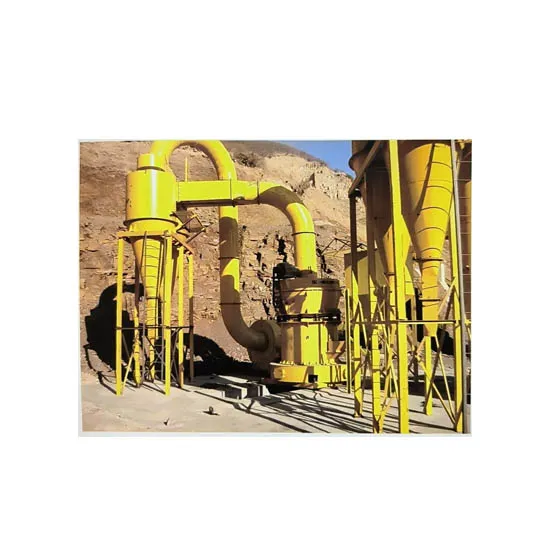
High-pressure mill is referred to as Raymond mill. It is a type of high-pressure suspension roller mill. YGM series high-pressure grinding mill is used for high-fine grinding processing of materials, and the particle size of the finished product can be adjusted within the mesh range (the finest can reach 800 mesh).
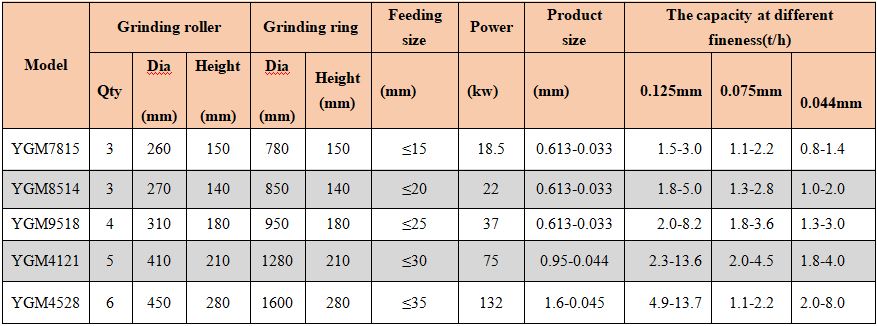
[Feeding particle size]: <35mm
【Production capacity】: 1-14t/h
[Application fields]: The high pressure mill is suitable for grinding the non-flammable and non-explosive materials with a Mohs hardness of not more than 9.3 and a humidity of less than 6%. .
[Applicable materials]: limestone, marble, dolomite, bentonite, activated carbon, gypsum, feldspar, kaolin, coke, silicon carbide
Product advantages
1, YGM series high-pressure grinding mill has a wide range of finished product particle sizes. The coarsest particle size can reach millimeters (30 mesh), the particle size can generally reach 0.033 mm (425 mesh), and a small number of materials can reach the smallest particle size of 0.013 mm (1000 mesh).
2,Small footprint and high efficiency
The high-pressure grinding mill is a vertical roller mill, which makes reasonable use of three-dimensional space and reduces land use. The equipment is lighter and more convenient for installation and debugging.
3, Good sealing and more environmentally friendly
The closed-circuit negative pressure environment is used for grinding, which makes reasonable use of the air flow. Multi-stage sealing ensures bearing life. Pulse or bag dust collector can be configured, and the dust removal effect fully meets the national dust emission standards.
FAQ
Q1:How to choose the right crusher (Jaw vs. Cone) for my mining project?
A1:Jaw crushers are typically used for primary crushing to handle large materials, while cone crushers are better suited for secondary and tertiary crushing of high-hardness materials like granite and basalt. Sanming Machinery customizes combinations such as "Jaw + Cone" or "Jaw + Impact" based on your feed size, material hardness, and output requirements.
Q2:What is the average production capacity (TPH) of Sanming mobile crushing plants for hard rock?
A2:Our mobile crushing plants cover a range of 50 TPH to 500 TPH. For example, when processing hard basalt, our standard configurations usually maintain a stable output of 150-200 TPH. The specific capacity depends on the feed size and the specifications of the final product.
Q3: How does Sanming Machinery ensure the longevity of crusher wear parts in abrasive environments?
A3:We use high-manganese steel (Mn13Cr2 or Mn18Cr2) for casting jaw plates and mantles, processed with a specialized heat treatment. With 18 years of manufacturing expertise, our wear parts offer 15%-20% higher durability than standard market options, significantly reducing maintenance downtime.
Q4:Can Sanming provide customized crushing and screening solutions for specific materials like granite or basalt?
A4:Yes. Sanming Machinery offers not just equipment, but one-stop EPC solutions. With over 1,880 global projects ranging from river stone sand-making in the Philippines to copper ore crushing in Congo, we provide customized flowcharts optimized for energy efficiency based on your specific material characteristics.
Q5:What after-sales support and installation services does Sanming offer for international clients?
A5:We provide "24-hour online response + on-site guidance." Our experienced engineers are dispatched to your project site for installation, commissioning, and operator training. Additionally, we maintain global spare parts warehouses to ensure urgent parts are shipped within 48 hours.