 English
 Russian

Article Summary: In hard rock quarrying (granite, basalt, quartzite), secondary crushing drives overall production cost and aggregate quality. This guide compares Multi-Cylinder Hydraulic Cone Crushers (PMH/HP series) with Single-Cylinder Hydraulic Cone Crushers (DMC/GP series), covering chamber kinematics, laminated crushing efficiency, wear part life, and complete crushing plant flowsheet design.
Language Switch: Читать статью на русском языке (RU)
1. Introduction: Secondary Crushing Dilemma in Hard Rock Quarrying
In aggregate production and mineral processing, secondary crushing represents the core bottleneck for both operating expenditure (OPEX) and product gradation. When processing hard and highly abrasive materials such as granite (compressive strength > 200 MPa), basalt, quartzite, and iron ore, selecting between a Multi-Cylinder Hydraulic Cone Crusher and a Single-Cylinder Hydraulic Cone Crusher determines:
Flakiness and particle shape of the finished aggregate (meeting high-spec asphalt and C50+ concrete standards).
Wear life of liners (mantle and bowl liner) under abrasive conditions.
Continuous production uptime during tramp iron / uncrushable events.

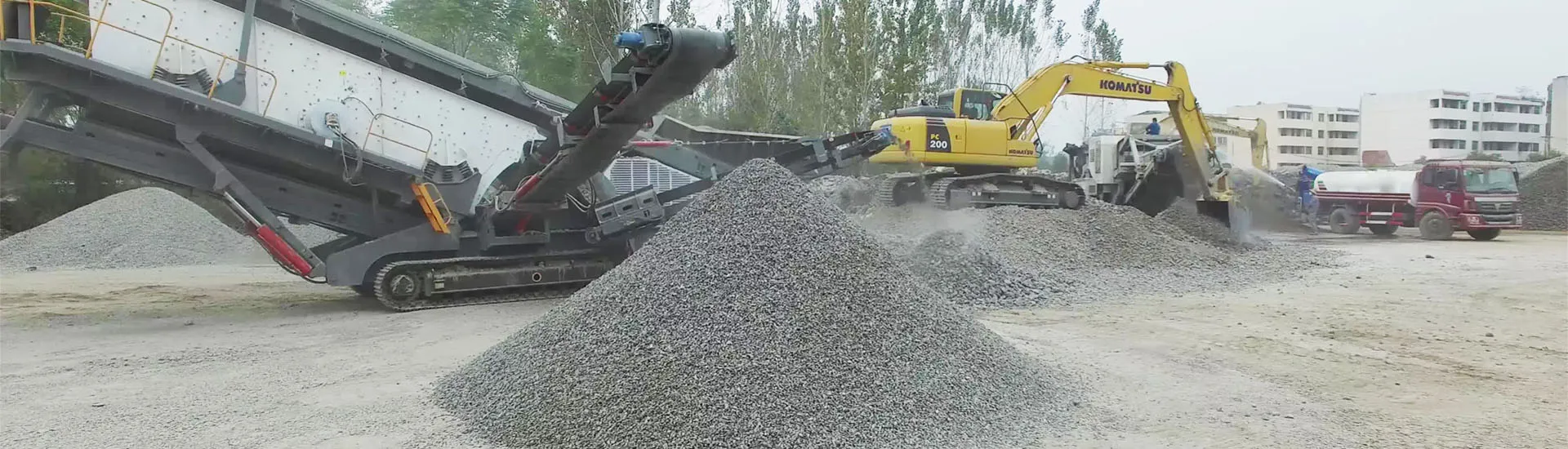
Figure 1: Sanming Machinery PMH Series Multi-Cylinder Hydraulic Cone Crusher operating in hard rock aggregate quarry.
2. Comprehensive Technical Comparison: Multi-Cylinder vs. Single-Cylinder
| Feature / Metric | Multi-Cylinder Hydraulic Cone (PMH / HP300 Series) | Single-Cylinder Hydraulic Cone (DMC Series) |
|---|---|---|
| Main Shaft Support & Kinematics | Fixed main shaft design; eccentric bushing rotates around the shaft, providing larger stroke and higher crushing force at discharge opening. | Moving main shaft supported by bottom hydraulic cylinder; lower pivot point with smaller stroke. |
| Laminated Crushing Action | Superior inter-particle crushing: higher rotational speed and large eccentric throw create dense particle layers, minimizing direct rock-on-metal abrasion. | Moderate inter-particle crushing; relies more on single-particle compressive cleavage. |
| Finished Aggregate Shape (Cubicity) | Excellent cubical shape with flakiness ratio typically < 8–12%; high proportion of fine aggregate in single pass. | Good product shape, but produces slightly higher elongation/flakiness on ultra-hard feed. |
| Tramp Iron Release | Multi-cylinder perimeter accumulator circuit: instant clearance of tramp metal with automatic return to original CSS setting. | Bottom cylinder hydraulic displacement drops main shaft; slower response to localized dynamic shock. |
| Discharge Setting (CSS) Regulation | Hydraulic motor drives adjustment bowl thread rotation; consistent chamber geometry during setting changes. | Single bottom cylinder lifts/lowers the shaft; changing CSS alters feed opening dimension slightly. |
| Best-Fit Process Position | Secondary, tertiary, and shaping stages for hard rock (Granite, Basalt, Diabase, River Stone). | Primary-secondary stage for medium-hard rock (Limestone, Dolomite) and high-throughput bulk reduction. |
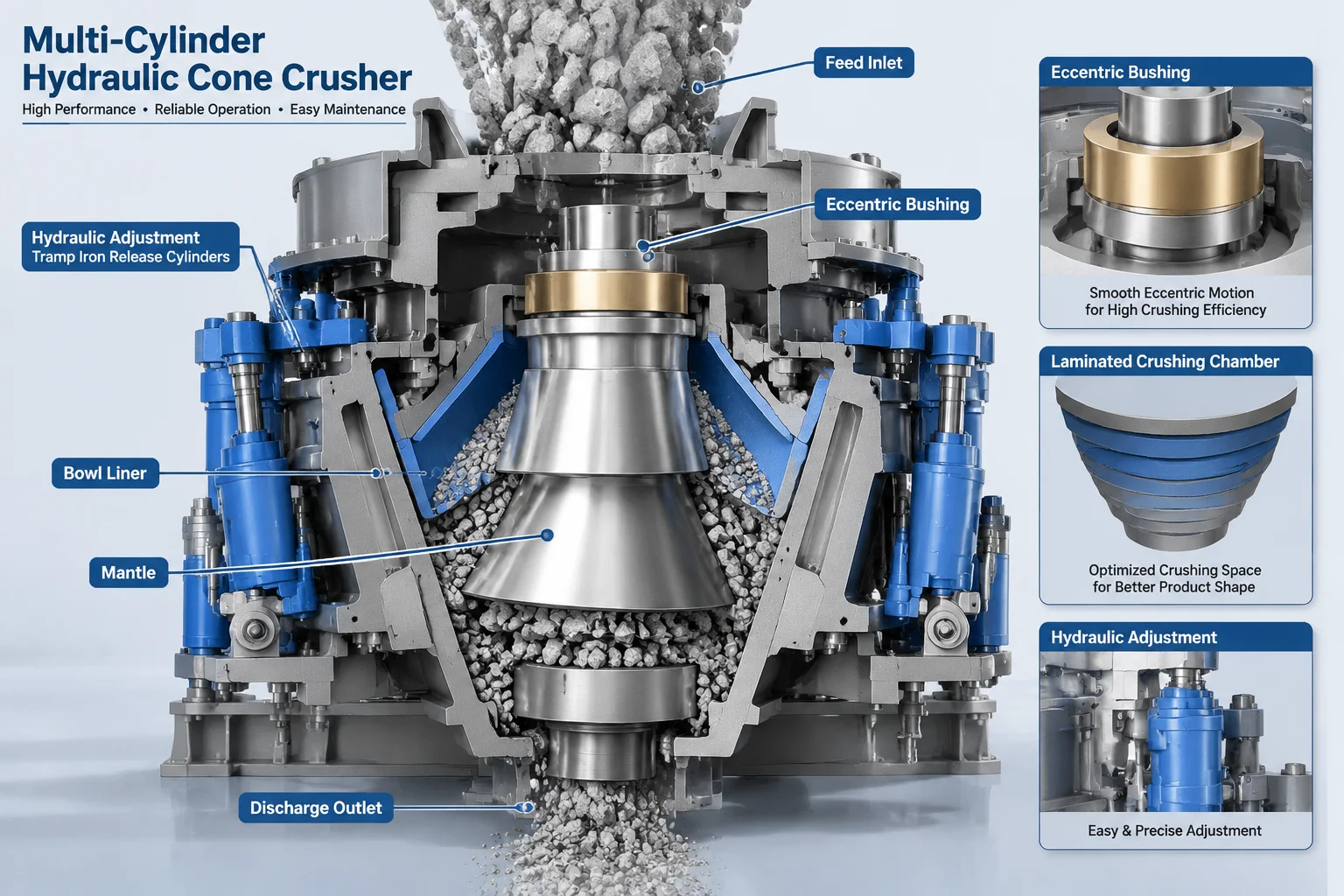
Figure 2: Engineering cross-section of multi-cylinder hydraulic cone crusher showing perimeter tramp release cylinders and laminated crushing cavity.
3. Optimal Quarry Circuit Configurations (150–400 TPH Flowsheets)
For aggregate producers targeting high-specification road and building construction materials, Sanming Machinery engineers recommend the following three-stage flowsheet:
Primary Stage: PEV European Jaw Crusher reducing R.O.M boulder rock (0-750 mm) down to 0-150 mm.
Surge & Feed Stage: Buffer surge bin equipped with heavy vibratory feeder ensuring continuous choke feeding.
Secondary Stage: PMH300 Multi-Cylinder Hydraulic Cone Crusher operating in closed circuit with a triple-deck vibrating screen.
Tertiary & Sand Making (Optional): VSI Vertical Shaft Impact Crusher for ultra-fine cubical sand making (0-5 mm).
4. Frequently Asked Questions (FAQ)
Q1: When should a quarry operator choose Multi-Cylinder over Single-Cylinder?
A: When the primary goal is producing high-quality cubical aggregate (such as high-grade asphalt surface coarse or C50+ railway concrete) from hard and abrasive rocks like granite and basalt, the multi-cylinder cone crusher offers superior crushing force and higher yield of premium fine fractions.
Q2: What is the typical wear part lifespan on basalt crushing?
A: With Sanming high-manganese alloy liners (Mn18Cr2 / Mn22Cr2), mantle and bowl liners deliver 350 to 550 operational hours under continuous choke-fed conditions, with rapid hydraulic disassembly reducing overhaul labor by 40%.
Q3: How does the tramp iron release system protect against machine damage?
A: Multiple perimeter hydraulic cylinders connected to nitrogen accumulators immediately allow the upper bowl to elevate when uncrushable metal passes, resetting to the precise preset CSS within seconds without stopping the drive motor.
Q4: Can Sanming Machinery retrofit or replace legacy Symons / Nordberg cone crushers?
A: Yes, Sanming supplies modular skid-mounted cone crushers and OEM-compatible wear parts designed to integrate seamlessly onto existing plant footings and conveyor networks.
5. Engineering Consultation & bauma CHINA 2026 Invitation
Planning a new quarry circuit, replacing aging crushing units, or seeking complete 100–1,500 TPH plant layout simulations? Meet the Hangzhou Sanming Machinery Co., Ltd. technical engineering team in person:
Event: bauma CHINA 2026 (Shanghai)
Dates: November 23 – November 27, 2026
Booth: Hall H1 · Booth H1.392
Official Portal: www.sanmingmachinery.com
Contact our engineering department to receive custom aggregate flowsheet calculations and exhibition-exclusive commercial quotes.