 English
 Russian

Optimizing Energy Consumption in Refractory Gold Comminution Circuits
In gold beneficiation plants, crushing and grinding represent between 50% and 70% of total electrical power expenditure. With declining ore grades and refractory quartz-vein host rocks featuring Bond Work Indices (BWi) exceeding 18–22 kWh/t, mining metallurgists must optimize the tertiary comminution boundary. High-Pressure Grinding Rolls (HPGR) and advanced multi-cylinder hydraulic cone crushers represent the two leading engineering routes to maximize downstream ball mill grinding efficiency. Sanming Machinery breaks down the structural mechanics, micro-crack generation, and CAPEX/OPEX tradeoffs of both technologies.
Mechanical Mechanics: Inter-Particle Bed Comminution Compared
Both machines leverage particle-bed compression rather than single-particle impact, but their operating physics diverge significantly:
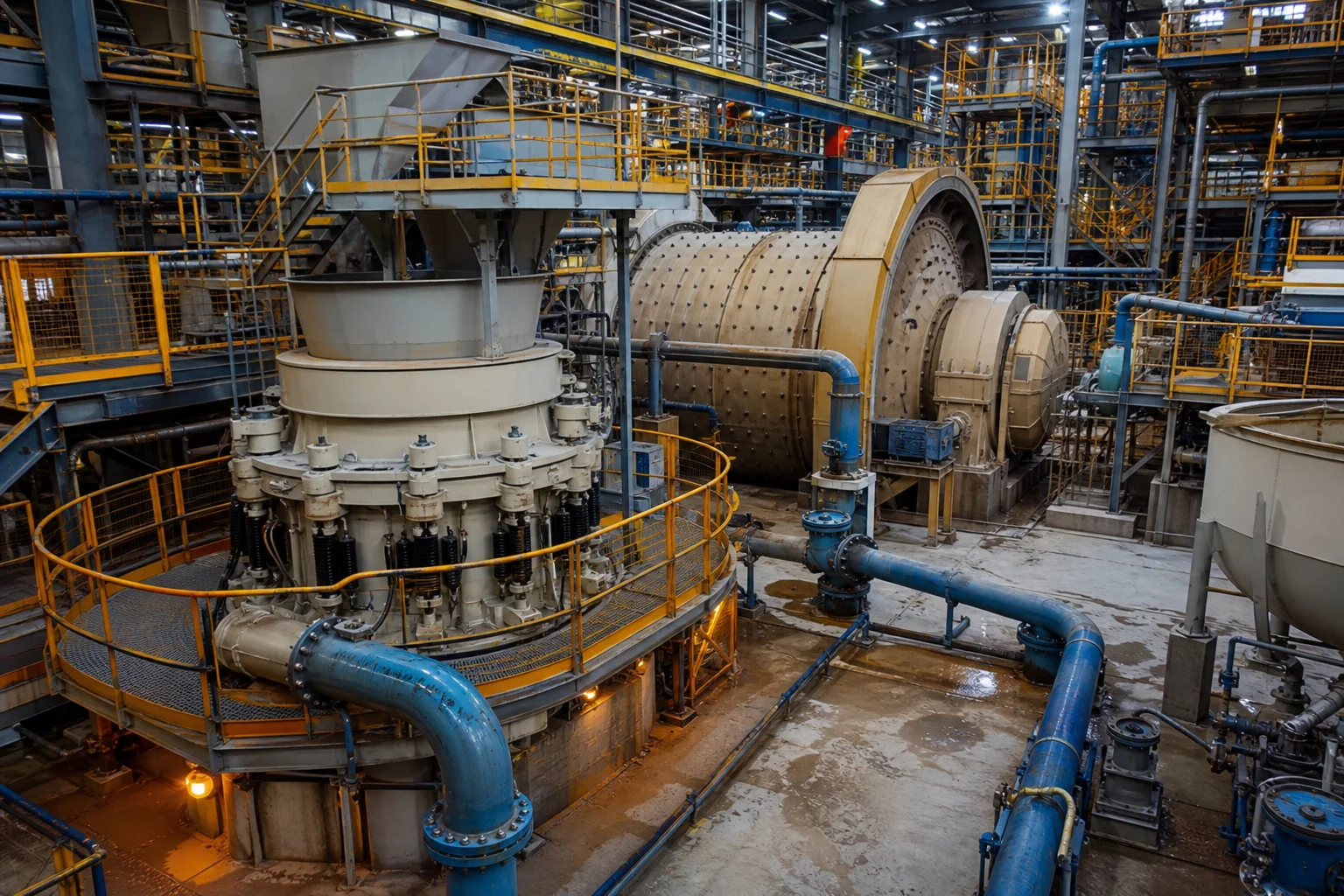
Multi-Cylinder Hydraulic Cone Crushers: High eccentric speeds (300–350 rpm) coupled with steep chamber angles subject descending rock strata to cyclic compressive impacts. Modern closed-side settings (CSS 6–10 mm) produce a fine, cubical discharge with a P80 below 8–12 mm while automatically clearing uncrushable tramp metal in under 1 second.
High-Pressure Grinding Rolls (HPGR): Counter-rotating rollers apply extreme specific pressing forces (2.5–4.5 N/mm²) via hydraulic cylinders directly through a choke-fed material bed. The intense quasi-static pressure induces extensive micro-fractures along mineral grain boundaries.
Downstream Grindability Effect: HPGR discharge reduces downstream ball mill Bond Work Index by 10–25% due to internal micro-fissuring, whereas modern multi-cylinder cone crushers offer superior moisture tolerance and significantly lower capital expenditure for plants processing under 500 TPH.
Technical Tradeoff Matrix: HPGR vs Multi-Cylinder Cone Crusher
| Engineering Metric | Multi-Cylinder Hydraulic Cone | High-Pressure Grinding Rolls (HPGR) | Metallurgical Impact |
|---|---|---|---|
| Initial CAPEX | Low to Moderate (1.0x baseline) | High (2.5x – 3.5x baseline) | Faster ROI for mid-tier gold projects |
| Feed Moisture Limit | Up to 6% – 8% without blinding | Strictly < 3% – 5% (caking risk) | Cone requires zero upstream drying |
| Ball Mill Energy Reduction | 10% – 15% through narrow P80 | 18% – 25% via micro-fracturing | HPGR excels in megatonnage mills |
| Wear Liner Replacement | Cast Mn18Cr2 (Low cost, rapid swap) | Tungsten carbide studded tires (High cost) | Lower operational risk on remote sites |
Technical FAQ: Gold Comminution Selection
Q1: When is a multi-cylinder hydraulic cone crusher superior to HPGR for gold ore?
For processing capacities below 400–600 TPH, or where feed contains variable clay and moisture above 5%, multi-cylinder cone crushers deliver lower CAPEX, simple maintenance, and consistent P80 without requiring costly heated screening or drying.
Q2: How does Sanming Machinery configure multi-cylinder cone crushers for high-silica gold quartz veins?
Sanming installs heavy-duty Mn22Cr2 high-manganese liners, automated lubrication oil cooling stations, and continuous hydraulic CSS setting adjustments under load to maintain high reduction ratios.