 English
 Russian
Primary Crushing Capital Allocation: Evaluating the Tipping Point
In large-scale quarrying and open-pit hard rock mining (granite, quartzite, basalt, taconite), the primary crushing station represents the single largest initial capital investment in mechanical equipment and reinforced concrete civil structures. Quarry engineers and project directors face a recurring technical dilemma when sizing circuits between 600 and 1500 metric tons per hour (TPH): should they deploy an extra-large single-toggle jaw crusher (such as a 1200x1500 mm or 1500x1800 mm unit) or invest in a heavy-duty hydraulic primary gyratory crusher? Making the wrong selection permanently impairs plant throughput or burdens the balance sheet with unrecoverable civil infrastructure expenditures.
Engineering & Operational Comparison Matrix
Sanming Machinery engineers evaluate primary crushing selections across four decisive physical and financial parameters:
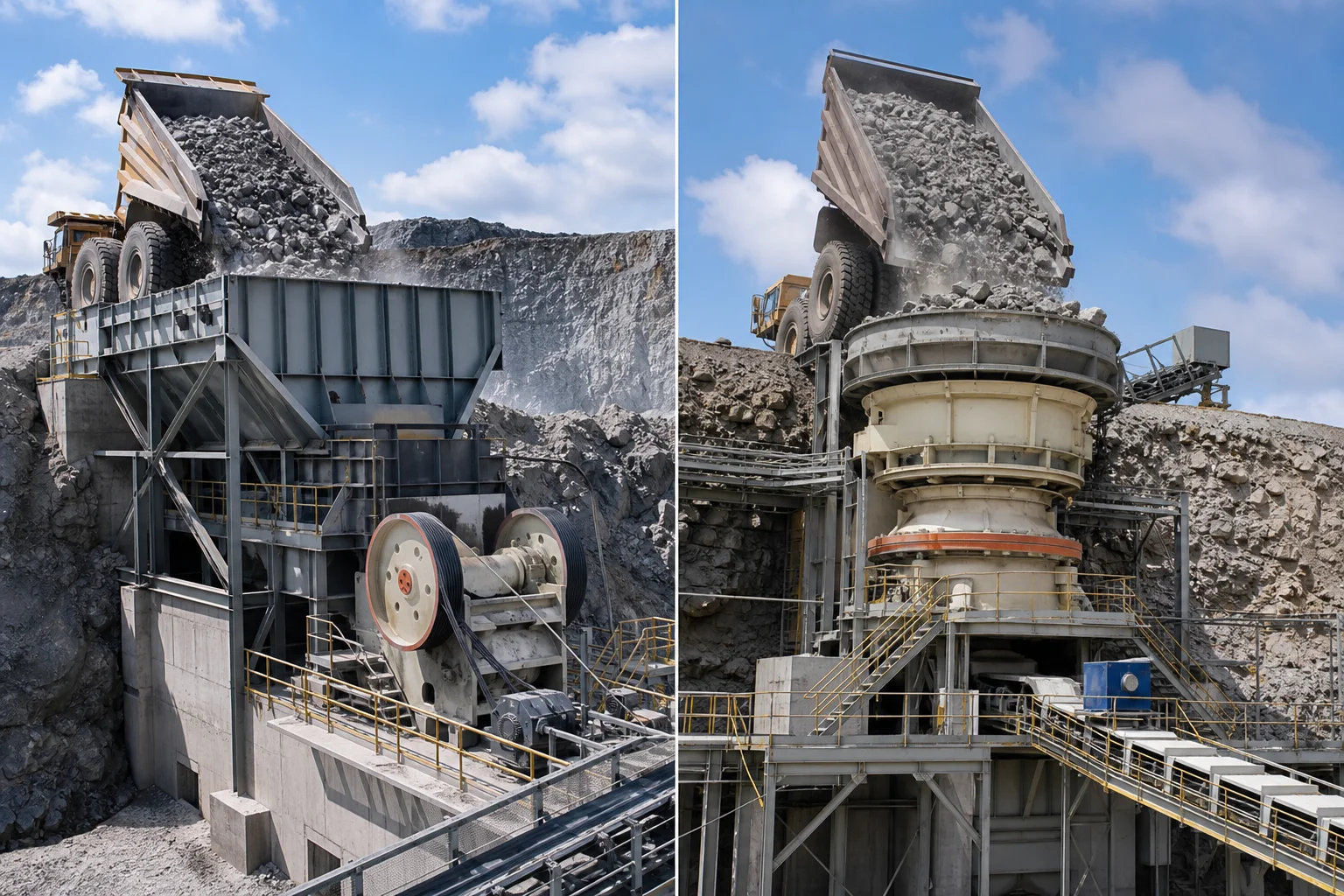
Throughput Capacity & Feed Opening Geometry: Jaw crushers operate with rectangular feed openings, crushing during 50% of the eccentric stroke cycle. Primary gyratory crushers utilize continuous circular crushing cavities, achieving continuous 360-degree reduction. For capacities exceeding 800–1000 TPH, a single gyratory easily replaces two parallel jaw crushing lines.
Slabby and Flat Blasted Rock Handling: Hard rocks with prominent bedding planes (such as laminated quartzites or gneisses) often blast into elongated slabs. In jaw crushers, slabby rocks can slip vertically through the rectangular jaw plates without undergoing adequate reduction, causing secondary crusher bridging. In gyratory crushers, the curved concave profile forces multi-point bending fracture, completely eliminating slab passage.
Direct Truck Dump Pocket vs. Vibrating Grizzly Feeder: Gyratory crushers feature enormous circular reception hoppers allowing direct dumping by two 60–100 ton haul trucks simultaneously without requiring a mechanical vibrating feeder. Jaw crushers strictly require heavy-duty vibrating grizzly feeders (such as Sanming ZSW series) to meter blasted rock and protect jaw dies.
Civil Foundation & Installation Depth (CAPEX Realities): While gyratories eliminate feeder costs, their vertical height demands deep, expensive concrete excavation (often 12–18 meters below dump level). Heavy jaw crusher installations require significantly shallower foundations (4–7 meters), saving up to 45% in civil concrete and structural excavation capital.
Liner Wear Life & Maintenance Turnaround: Sanming heavy jaw dies (cast in Mn18Cr2 / Mn22Cr2) are reversible, allowing top-to-bottom die rotation to maximize wear metal utilization. Gyratory mantle and concave segments require specialized overhead crane rigging during relining.
Engineering Selection Guidance from Sanming Machinery
For quarry throughputs below 700 TPH, heavy PE jaw crushers provide superior Return on Invested Capital (ROIC). For operations sustained above 1000 TPH processing abrasive, slabby ore, Sanming hydraulic gyratories deliver unmatched uptime and lower operating cost per ton.
Technical FAQ: Primary Crusher Selection
Q1: Can an extra-large jaw crusher handle direct truck dumping without a feeder?
No. Blasted rock boulders dumped directly onto jaw dies create extreme point shock loads, risking pitman bearing fracture and toggle plate buckling. A heavy-duty vibrating grizzly feeder is mandatory.
Q2: How does rock compressive strength influence liner wear between jaw and gyratory crushers?
In ultra-hard abrasive rock (UCS > 220 MPa), jaw die rubbing causes accelerated localized grooving near the discharge zone. Gyratory circular crushing exhibits lower relative slip friction, distributing wear across a larger mantle surface area and extending reline cycles by 30%.