 English
 Russian

The Challenge of Low-Grade and High-Silica Bauxite in Modern Alumina Refineries
In global alumina production via the Bayer process, the ratio of alumina to reactive silica—known as the Silica Modulus (A/S ratio, Al2O3/SiO2)—is the critical metric determining refinery profitability. Low-grade gibbsitic and boehmitic bauxite deposits (such as those in Guinea, Indonesia, Australia, and Brazil) often carry heavy kaolinite and goethite clay contamination. Reactive silica consumes caustic soda (NaOH) during digestion, creating massive volumes of hazardous bauxite residue (red mud). Implementing advanced crushing, scrubbing, and wet desliming circuits is the most cost-effective mechanical route to upgrade low-grade bauxite before chemical refining.
Sanming Machinery Bauxite Beneficiation Circuits and Equipment
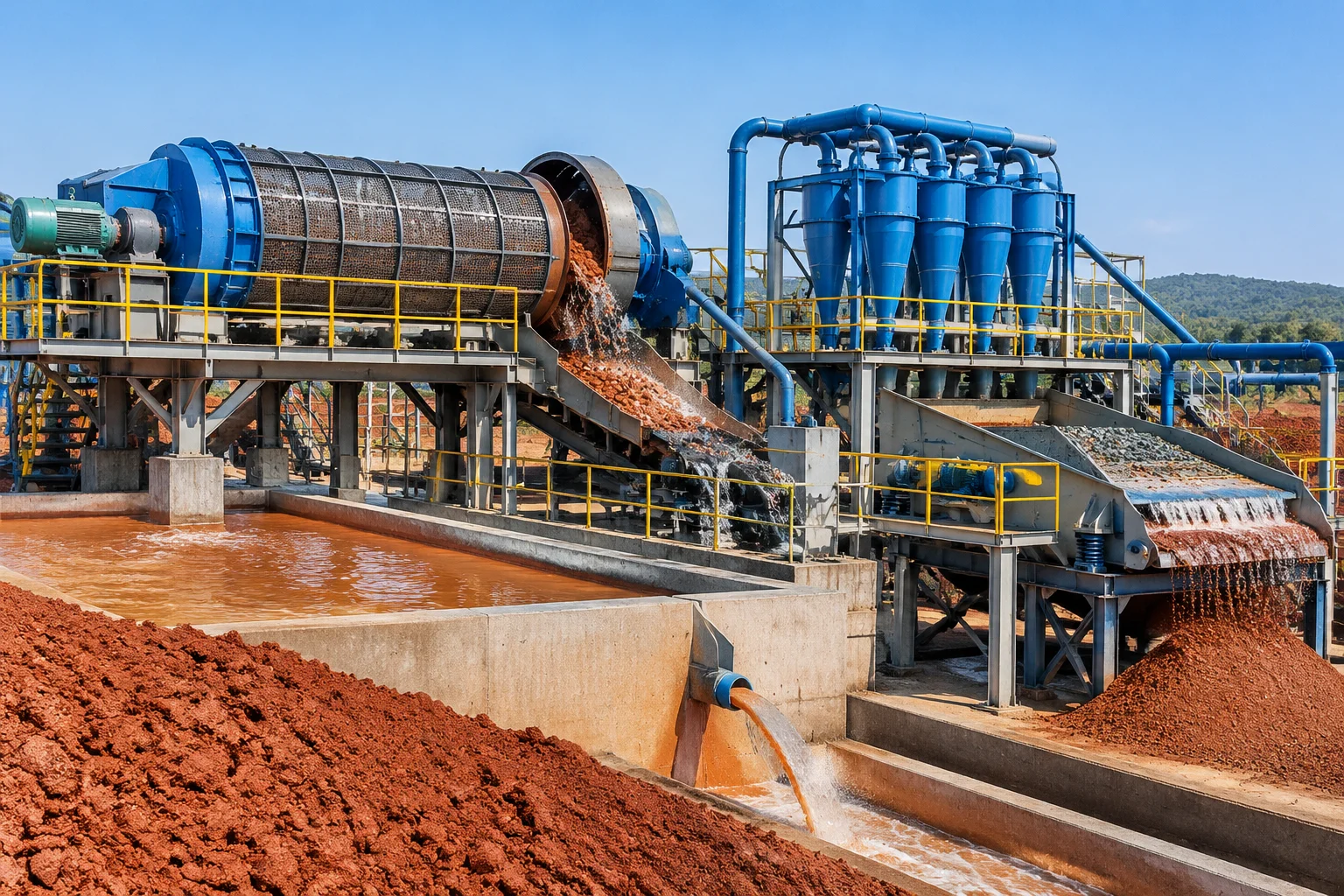
Primary Jaw Crushing with Mud-Bypass Feeders: Run-of-mine (ROM) lateritic bauxite contains sticky plastic clays that blind conventional grizzly feeders. Sanming integrates heavy-duty apron feeders and multi-stage vibrating finger grizzlies ahead of large-clearance PE jaw crushers, diverting fine wet clays directly to washing streams.
Heavy-Duty Rotary Scrubbers and Trommel Screens: High-density autogenous scrubbing in heavy rotary scrubber drums disintegrates tough clay agglomerates through inter-rock tumbling and high-pressure water injection. Replaceable internal lifter bars and rubber liners ensure thorough clay dispersion without pulverizing valuable bauxite nodules.
Twin-Shaft Log Washers for Plastic Clays: For tenacious clay-bound ores, Sanming heavy-duty log washers utilize high-torque contra-rotating shafts with high-chromium paddles to aggressively shear and wash clay coatings from bauxite lumps sized 10 mm to 75 mm.
Hydrocyclone Classification and Slime Dewatering: The washed slurry reports to hydrocyclone clusters that sharply separate ultra-fine kaolinite clays (-0.045 mm) into the overflow waste slimes, while coarse enriched bauxite sand is dewatered on high-frequency vibrating screens.
Tangible Operational Gains for Alumina Producers
Upgrading raw bauxite through Sanming scrubbing circuits boosts the Silica Modulus (A/S) from 3.5–5.0 up to 7.0–10.0+, reducing caustic soda consumption by 20% to 35% and substantially curbing red mud generation per ton of refined alumina.
Technical FAQ: Bauxite Washing and Beneficiation
Q1: How much water is required for bauxite rotary scrubber washing, and can it be recycled?
Typical bauxite washing circuits require 1.5 to 2.5 m³ of water per ton of raw ore. By pairing the washing circuit with Sanming high-rate thickeners and chamber filter presses, over 85% of the wash water is clarified and continuously recycled back to the scrubbers.
Q2: How do you prevent screen blinding when classifying sticky washed bauxite?
Sanming uses polyurethane modular screen panels equipped with flexible self-cleaning apertures and high-pressure water spray manifolds (2.5–4.0 bar) to keep screen decks open and free of clay buildup.