 English
 Russian
1. Kinematics of Primary Crushing and Cavity Packing Mechanics
In high-tonnage mining and quarry circuits, the single-toggle jaw crusher remains the cornerstone for primary size reduction. However, operational efficiency is frequently compromised by premature jaw die wear and intermittent cavity packing (pancaking). Under intense compressive stress, rock fragmentation relies on the downward elliptical stroke imparted by the overhead eccentric shaft. When unscalped fines enter the crushing zone alongside massive run-of-mine boulders, the interstitial void ratio drops drastically. Rather than fracture via tensile splitting, fine particles compact into high-density briquettes that pack into the lower tooth root valleys, causing severe hydraulic pressure buildup in the pitman assembly and rapid frictional wear.
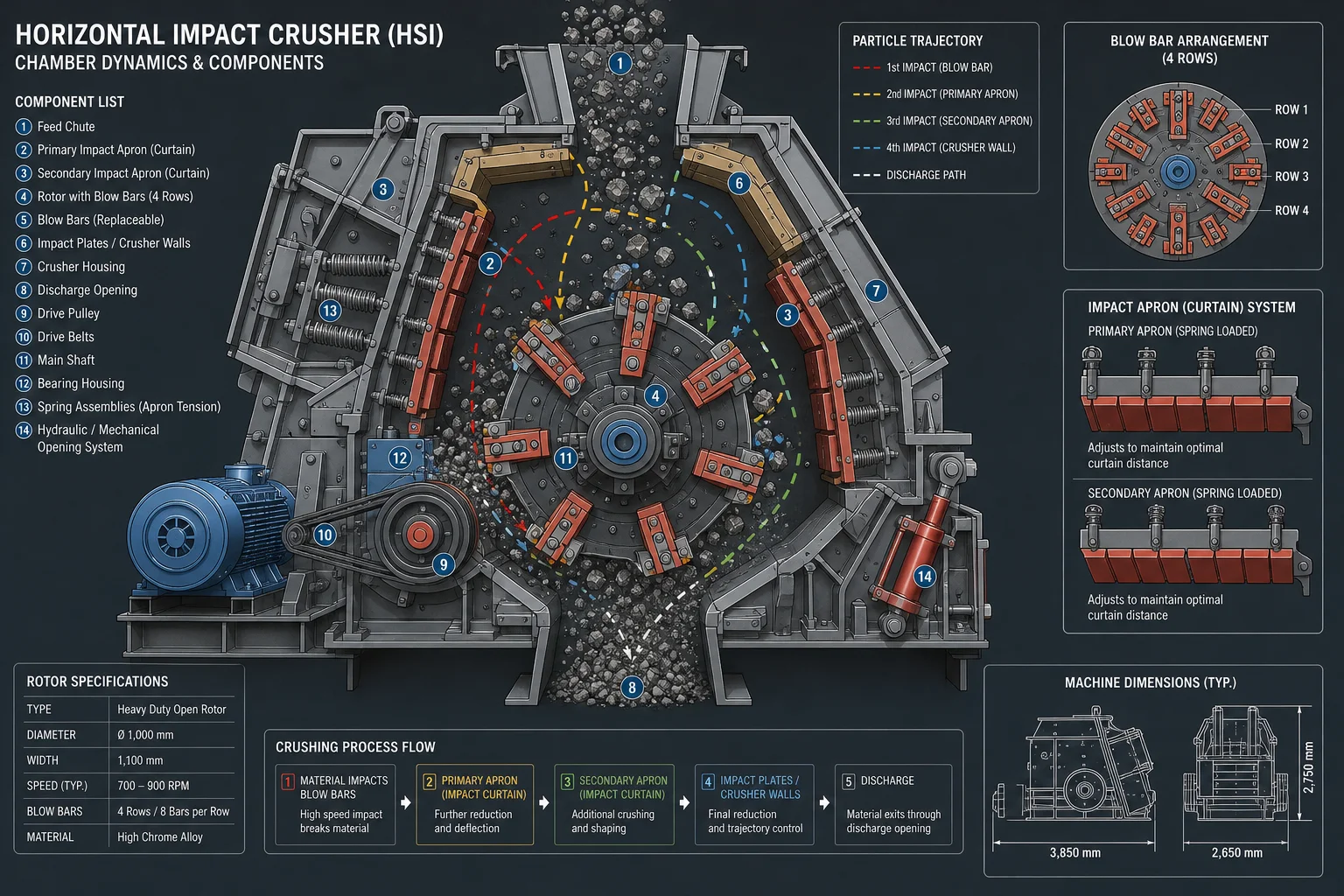
Figure 1: Cross-sectional kinematic profile and force distribution in a single-toggle jaw crushing chamber
2. Manganese Work-Hardening vs. Abrasive Gouging
Standard austenitic manganese steels (Hadfield steel, typically Mn14Cr2 to Mn18Cr2) require repeated, high-energy impact loading to transform the austenitic matrix into high-hardness martensite (hardening from ~220 HBW up to 500–550 HBW). When a jaw crusher is starved or fed non-scalped feed containing abrasive quartz sand (-40mm fines), the impact energy is diffused through fine bed compression. Under these conditions, the alloy fails to reach its full work-hardened potential, leading to micro-cutting, gouging, and rapid loss of the corrugated tooth profile. Sanming Machinery recommends installing high-amplitude vibrating grizzly feeders equipped with tapered stepped grizzly bars to bypass sub-mesh material ahead of the primary chamber, directly cutting liner wear rates by 25% to 35%.
3. Choke Feed Optimization and Tooth Profile Alignment
Operating under consistent choke-feed conditions ensures symmetrical rock-on-rock interparticle breakage, transferring compressive loads evenly across the movable and stationary jaw plates. Irregular trickle feeding allows rock slabs to bounce and slam against the upper stationary jaw, creating localized hollows that disrupt the crushing angle (nip angle). Maintaining an engineered nip angle between 18° and 22° prevents material slippage and ensures continuous downward draw, maximizing production throughput while stabilizing electric motor amperage.
Technical FAQ — Primary Crushing Best Practices
Q1: What is the optimal grizzly bypass setting for hard abrasive granite?
A1: For granite with silica content exceeding 65%, the vibrating grizzly opening should be set to match the crusher's Closed Side Setting (CSS), typically 90mm to 120mm. Bypassing minus-40mm natural abrasive dirt prevents severe grinding wear in the lower parallel zone.
Q2: When should jaw plates be rotated top-to-bottom?
A2: Jaw plates exhibit maximum wear in the lower bottom third. Rotation should occur when the bottom tooth height has degraded by 50% to 60%. Delaying rotation until the teeth are completely flush risks frame damage and reduces overall wear part utilization by over 20%.
Q3: How does moisture in pit-run material aggravate cavity packing?
A3: Clayey pit-run moisture above 4% transforms bypassed fines into sticky slurry. Under compressive force, this creates a cohesive cake inside the teeth corrugations, choking discharge and causing high-pressure toggle plate failure.